


Institute of Energy


The Institute provides training of specialists in the following fields: “Electrical Power Engineering and Electrical Engineering,” “Thermal Power Engineering and Heat Engineering,” and “Technosphere Safety,” through 11 Bachelor’s educational programs and 9 Master’s educational programs.
The Institute employs 109 academic staff members, including 9 Doctors of Sciences and about 40 Candidates of Sciences. The total number of students enrolled in full-time and distance learning programs is more than 1,800, including 800 Bachelor’s students, 114 Master’s students, and 16 PhD (postgraduate) students.
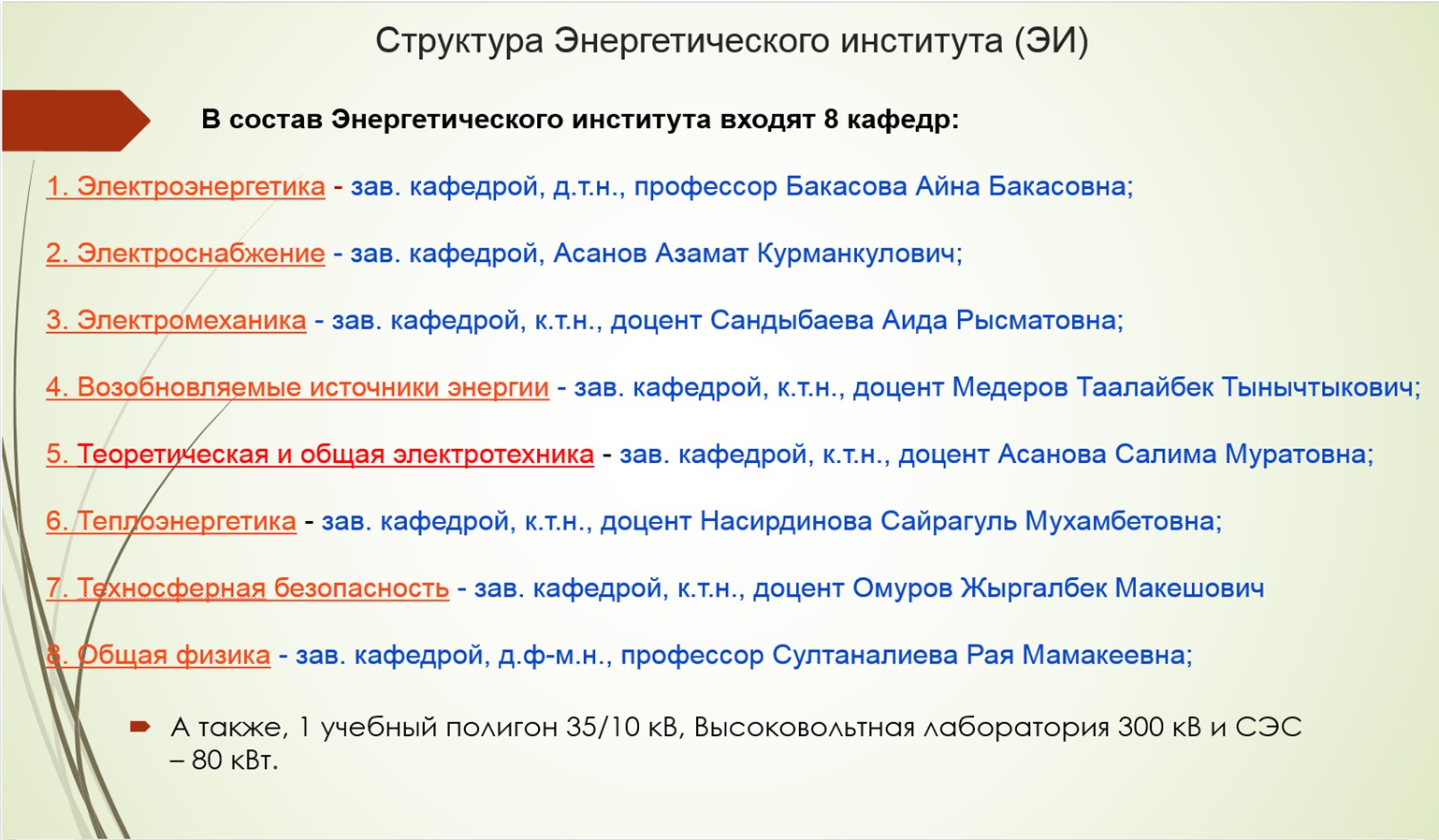
Today, the Energy Institute consists of 8 departments:
Objectives of the Institute’s Educational Activities under Academic Programs
Objectives of Educational Activities of the Energy Institute of KSTU named after I. Razzakov under Bachelor’s Programs
The objective of the Bachelor’s degree programs is to prepare specialists with a strong fundamental engineering background in the field of energy and electrical engineering, equipped with basic professional competencies, practical skills, and readiness to perform professional duties in entry-level engineering and operational positions.
Main objectives of the Bachelor’s programs:
- Formation of fundamental knowledge in mathematics, physics, electrical engineering, thermal power engineering, and related engineering disciplines.
- Development of basic professional competencies in the generation, transmission, and distribution of electrical energy, as well as renewable and thermal energy systems.
- Acquisition of practical skills in the operation of energy equipment, systems, and installations in real industrial conditions.
- Development of skills in using modern digital and information technologies and automated control systems in the energy sector.
- Formation of responsibility for professional outcomes, adherence to industrial, environmental, and energy safety standards.
Objectives of Educational Activities of the Energy Institute of KSTU named after I. Razzakov under Master’s Programs
The objective of Master’s degree programs is to prepare highly qualified specialists and researchers capable of independent scientific research, design, analytical, and managerial activities in the energy sector using modern technologies and innovative approaches.
Main objectives of the Master’s programs:
- Deepening and expanding professional knowledge in energy, electrical engineering, and energy systems, including modern and emerging fields.
- Formation of competencies in research activities, including the ability to define and solve scientific and engineering problems and analyze research results.
- Development of skills in designing, modeling, and optimizing energy systems using digital technologies and specialized software.
- Preparation of specialists capable of making technical and managerial decisions under uncertainty and rapidly changing technological conditions.
- Development of readiness for innovation, academic careers, and lifelong learning, including preparation for PhD doctoral studies.
History of the Institute
In the 1950s, due to the intensive development of hydropower resources, the implementation of a program for constructing power plants and high-voltage transmission lines, there arose a strong need in the republic for electrification of industry and all agricultural sectors, as well as for training specialists in the energy field, which became a requirement of the time.
In 1953, the Technical Faculty was established on the basis of the Kyrgyz State Pedagogical Institute named after M.V. Frunze (now Kyrgyz National University). A department for training specialists in the energy field was opened within the faculty, and 25 students were admitted to the specialty “Electrification of Industrial Enterprises.”
On the basis of Resolution No. 532 of the Council of Ministers of the Kirghiz SSR, the Kyrgyz State Polytechnic Institute was established. The newly created institute was tasked with opening mining, construction, energy, and chemical-technological faculties and enrolling 200 students by October 1, 1954. General education and technical departments were established, strengthening their material and technical base. In 1954, the departments “Philosophy and Social Sciences” and “Physics” were created. In the first academic year (1954–1955), 68 students studied in the field of “Energy.” In the early years, the faculty was called the Construction-Energy Faculty and was later divided into two independent faculties—Construction and Energy—in 1957. That same year, the Energy Faculty was officially established, preserving its identity, traditions, and experience for more than half a century.
Undoubtedly, the invaluable contribution of the Deputy Director for Academic Affairs, Candidate of Technical Sciences, Associate Professor Vasiliy A. Andreev, should be noted in organizing the educational and scientific work of the new faculty.
In the early years, the Energy Faculty was headed by engineer Yevgeny V. Shonin. The establishment of the departments “Electrification of Industrial Enterprises” and “Electrical Engineering” in 1955, “Heat Engineering and Hydraulics” in 1956, and “Power Stations, Networks and Systems” in 1957 became a strong foundation for training local specialists for the country’s energy system.
The first graduation of electrical engineers took place in 1958. These graduates made a significant contribution to the energy sector of Kyrgyzstan, including the construction of the Alamudun HPP, Issyk-Ata HPP, Uch-Kurgan HPP, 110–35 kV transmission lines Andijan–Kara-Suu–Osh and in the Chui region, as well as the Bishkek TPP, among others.
To support automation and adjustment of technological processes in power plants, high-voltage lines, and industry, the Department of “Automation and Telemechanics” was opened in 1960, and in 1965 the Department of “Electrical Machines and Apparatus” was established.
A significant contribution to the development of these departments was made by Academician N. Yu. Nebolyubov and Associate Professor B.A. Gusev in training scientific personnel, academic staff, and developing laboratory facilities. In 1967, the Department of “Heat Engineering and Hydraulics” was divided into two independent departments: “Heat Engineering” and “Hydraulics.”
In 1967, the Department of “Electrification of Industrial Enterprises” was transformed into the Department of “Electric Drive and Automation of Industrial Equipment.” Due to the development of agriculture and livestock farming, the Department of “Power Supply of Urban and Rural Networks” was established in 1970, headed by Associate Professor V.A. Yurikov.
To provide the country with highly qualified personnel, by 1980 the Energy Faculty employed 127 academic staff across 11 departments, including “Power Stations, Networks and Systems,” “Power Supply of Urban and Rural Networks,” “Electric Drive and Automation of Industrial Equipment,” “Heat Engineering,” “Theoretical Foundations of Electrical Engineering,” “Labor Protection,” “Technical Physics,” “Electrical Machines and Apparatus,” “Automated Control Systems and Computing Technology,” and “Industrial Electronics.”
Due to the development of communication technologies in industrial facilities, radio, television, computing and electronic systems, the institute faced the task of training specialists for these fields. As a result, in 1984 the Faculty of “Production Management Automation” was established. Several departments were transferred from the Energy Faculty, including “Automation and Telemechanics,” “Automated Control Systems and Computing Technology,” “Industrial Electronics,” “Electric Drive and Automation of Industrial Equipment,” and “Technical Physics.”
Later, the Faculty of Production Management Automation was reorganized, and in 1999 the Faculty of Information Technologies (formerly Production Management Automation) was separated from the Energy Faculty.
In 2001, according to the decision of the Academic Council of KSTU dated 26.10.2001, the Department of “Electric Power Engineering” was divided into three departments: “Electric Power Engineering,” “Power Supply,” and “Renewable Energy Sources.”
In 1956–1957, the Construction-Energy Faculty was headed by N.P. Klimenko.
Directors of the Energy Institute and their terms of office:
1957–1959 — E.V. Shonin
1959–1964 — K.E. Golubkov
1964–1971 — M.G. Polyakov
1971–1974 — S.N. Nazarov
1974–1975 — A.A. Shaymergenov
1975–1977 — K.R. Rakhimov
1977–1984 — V.A. Yurikov
1984–1986 — B.T. Ukuyev
1986–1987 — A.S. Dzhamanbaev
1987–1992 — A.N. Kozlov
1992–1996, 1999–2006, 2008–2013 — M.A. Suerkulov
1996–1999 — S.S. Kadyrkulov
2006–2008 — J.A. Apyshov
2013–2015 — Zh.T. Galbaev
2015–2018 — Ch.A. Kadyrov
2018–2023 — Zh.T. Galbaev
2023–2024 — B.R. Tentiev
2024–2025 — A.R. Akparaliev
2025–present — A.U. Kalmatov


